

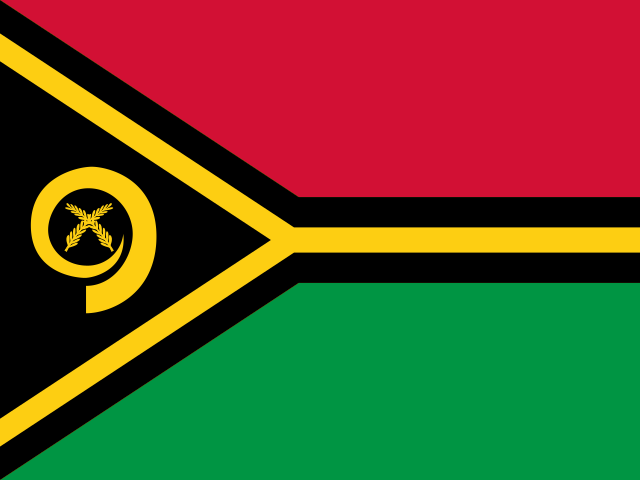
 Torres Islands
Torres Islands at a Glance
About Torres Islands
The Torres Islands are a small archipelago in northern Vanuatu, administratively part of Torba Province. They are remote, largely volcanic islands with small, traditional communities.
Islands in the group are inhabited by a few small villages where residents practice fishing, horticulture and customary activities; local languages belong to the Torres-Banks language family. Transport connections are intermittent and provided by small aircraft and irregular boats.
Historically the islands have retained strong local cultural traditions and limited outside settlement due to their remoteness. The islands form the northern extremity of the Republic of Vanuatu.
Geographically the Torres Islands lie north of the larger Banks Islands and are the northernmost inhabited part of Vanuatu, set in the southwestern Pacific Ocean.
- Provincial status: Part of Vanuatu’s Torba Province and representing the northernmost inhabited islands of the country.
What to See#
- Hiw: Hiw Island - one of the largest and most northerly inhabited islands in the group, with local villages and traditional communities.
- Tegua and Toga: Tegua and Toga - small inhabited islands with scattered villages, local subsistence economies and traditional languages.
- Linua airstrip: Linua - a small island used as a local transit point with a short airstrip serving inter-island flights.
Tips for Visiting Torres Islands
- Treat travel logistics as the first priority: the Torres Islands are remote within Torba Province, so check inter-island flight and boat schedules well in advance and confirm return options before you leave a mainland hub.
- Bring sufficient local cash and supplies from the larger islands - facilities and ATMs are very limited on the Torres Islands, and shops may be infrequent.
- Respect local customs and ask permission before photographing people or private village areas; cultural protocols and hospitality are important in these small island communities.
Best Time to Visit Torres Islands
The islands are best visited in the drier months (May-October) when sea conditions and weather are more reliable.
Weather & Climate near Torres Islands
Torres Islands's climate is classified as Tropical Rainforest - Tropical Rainforest climate with consistently warm temperatures year-round. Temperatures range from 22°C to 30°C. Heavy rainfall (3936 mm/year), wettest in March.
| Month | Comfort | Temp | Feels | Rain | Sky | Humidity | Wind | UV | Daylight |
|---|---|---|---|---|---|---|---|---|---|
| January | - | 24° - 30° | 27° | 417 mm | - | - | 2.7 m/s | - | - |
| February | - | 24° - 30° | 27° | 391 mm | - | - | 2.3 m/s | - | - |
| March | - | 24° - 30° | 27° | 426 mm | - | - | 2.5 m/s | - | - |
| April | - | 24° - 30° | 27° | 359 mm | - | - | 2.2 m/s | - | - |
| May | - | 23° - 29° | 26° | 408 mm | - | - | 2.8 m/s | - | - |
| June | - | 23° - 28° | 26° | 332 mm | - | - | 2.7 m/s | - | - |
| July | - | 23° - 28° | 25° | 339 mm | - | - | 3.2 m/s | - | - |
| August | - | 22° - 28° | 25° | 295 mm | - | - | 3.1 m/s | - | - |
| September | - | 22° - 28° | 25° | 211 mm | - | - | 3.2 m/s | - | - |
| October | - | 23° - 29° | 26° | 225 mm | - | - | 3.0 m/s | - | - |
| November | - | 23° - 30° | 26° | 269 mm | - | - | 2.9 m/s | - | - |
| December | - | 23° - 30° | 27° | 264 mm | - | - | 2.6 m/s | - | - |